Cagrilintide
Also known as: amylin analogue, AM833, amylin analogue cagrilintide
Long-acting amylin analogue studied in combination with semaglutide for profound weight reduction in obesity models.
Quick Reference
Cagrilintide - Research Images
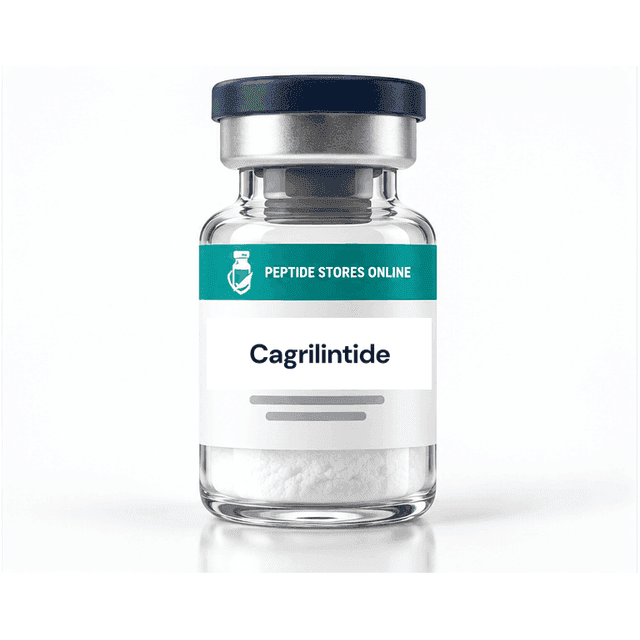
PSO vial render · Scientific images from Wikipedia · Tap to enlarge
Overview

Chemical compound
Cagrilintide is a long-acting analogue of amylin. It is being tested to treat obesity and type 2 diabetes by itself and in combination with semaglutide as cagrilintide/semaglutide ("CagriSema").
Mechanism of Action
Cagrilintide is a long-acting analogue of amylin. It is being tested to treat obesity and type 2 diabetes by itself and in combination with semaglutide as cagrilintide/semaglutide ("CagriSema").
What is Cagrilintide?
Cagrilintide is a laboratory-made, long-lasting version of amylin, a hormone the pancreas releases alongside insulin after meals. Researchers study it for appetite and body-weight regulation. In large clinical trials it produced meaningful weight loss on its own and even larger loss when researchers paired it with semaglutide.
How It Works - Simply Explained
Amylin helps the brain sense fullness after eating and slows how quickly food leaves the stomach. Cagrilintide was built to copy that signal for much longer than natural amylin lasts. It activates amylin and related calcitonin receptors in appetite-control areas of the brain, which in studies reduced food intake through a pathway separate from GLP-1 drugs like semaglutide. That separate pathway is why researchers became interested in combining the two signals.
What Studies Have Found
First long-acting amylin drug to show weight loss in a phase 2 trial
In a 26-week randomized trial in adults with overweight or obesity, researchers found weight fell in a clear pattern as the studied amounts increased, reaching about 10.8 percent on average in the highest group compared with about 3 percent with placebo. The result also compared favorably with an established daily GLP-1 medicine in the same trial, showing the amylin pathway could drive weight loss by itself.
Lau DCW et al., 2021, The Lancet
Pairing amylin and GLP-1 signals nearly doubled early results
In an early combination study, researchers paired cagrilintide with semaglutide and observed substantially greater weight loss than with semaglutide alone over 20 weeks. The two compounds did not appear to interfere with each other in the body, which gave researchers a practical reason to test the pairing in much larger trials.
Enebo LB et al., 2021, The Lancet
Phase 3 combination reached about 22.7 percent average weight loss
In the large REDEFINE 1 trial in adults with obesity or overweight and a weight-related condition, the cagrilintide and semaglutide combination produced about 22.7 percent average weight loss after 68 weeks when participants followed the treatment plan, compared with about 2.3 percent with placebo. Stomach-related side effects were the most common issue reported, and were usually temporary and mild to moderate.
Garvey WT et al., 2025, New England Journal of Medicine
Cagrilintide alone also worked in phase 3
A sub-analysis of REDEFINE 1 looked at cagrilintide by itself and found about 11.8 percent average weight loss after 68 weeks, compared with about 2.3 percent with placebo. About one in three participants in that group lost at least 15 percent of body weight. On the strength of these results, the developer announced a dedicated follow-up phase 3 programme for cagrilintide on its own.
Garvey WT et al., 2025, New England Journal of Medicine, REDEFINE 1 sub-analysis presented 2025
Combination also improved blood sugar in type 2 diabetes trial
In REDEFINE 2, researchers studied the same combination in adults with obesity and type 2 diabetes. They observed strong improvements in long-term blood sugar control alongside major weight loss, with far more participants reaching a commonly used blood sugar target than in the placebo group. This broadened interest beyond weight alone into metabolic health.
Davies MJ et al., 2025, New England Journal of Medicine
Last updated 2026-10-12. New findings are added as published research appears.
Frequently Asked Questions
What is cagrilintide?
Cagrilintide is a synthetic, long-acting version of amylin, a natural hormone involved in fullness and meal control. It is an investigational compound studied in clinical trials for weight and metabolic research, and the material sold here is for laboratory research use only, not for human consumption.
How is cagrilintide different from semaglutide?
They copy different natural signals. Semaglutide mimics GLP-1, while cagrilintide mimics amylin. Because the pathways are different, researchers have studied them together and observed larger effects from the combination than from either signal alone in trials.
What is CagriSema?
CagriSema is the name used in research for the combination of cagrilintide and semaglutide studied in the REDEFINE trial programme. It is not a separate single molecule; it is the two compounds studied together.
Is cagrilintide FDA approved?
No. As of the studies cited here, cagrilintide remains investigational and is not an FDA-approved medicine on its own or in combination. Trial results do not equal approval.
What side effects were reported in cagrilintide studies?
Researchers most often reported stomach-related effects such as nausea, vomiting, diarrhea, and constipation. In the large trials these were usually described as temporary and mild to moderate, and only a small share of participants stopped treatment because of nausea.
Why are researchers excited about amylin?
Amylin offers a different appetite-control route from GLP-1. The phase 2 and phase 3 results showed that route can produce meaningful weight loss alone and add to GLP-1 results, which is rare for a new metabolic pathway.
What Researchers Are Saying
Community Reports - Not Medical Advice
The following is aggregated from public forums, Reddit, and research communities. These are anecdotal reports from researchers only - not verified clinical data and not a recommendation of any kind.
Cagrilintide (also known as amylin analogue, AM833) is studied within the metabolic health research community. Long-acting amylin analogue studied in combination with semaglutide for profound weight reduction in obesity models.
Last updated October 28, 2026
Research status: emerging. Cagrilintide appears across metabolic health research forums and academic literature. Researchers note this compound falls in the metabolic category.
Last updated October 28, 2026
What Do You Think of This Peptide?
Share your opinion or research experience with Cagrilintide. Comments are reviewed before appearing.