GHRP-6
Also known as: ghrp6, growth hormone releasing peptide 6, SK&F-110679
GH secretagogue studied for GH release and appetite stimulation via ghrelin receptor activation.
Quick Reference
GHRP-6 - Research Images
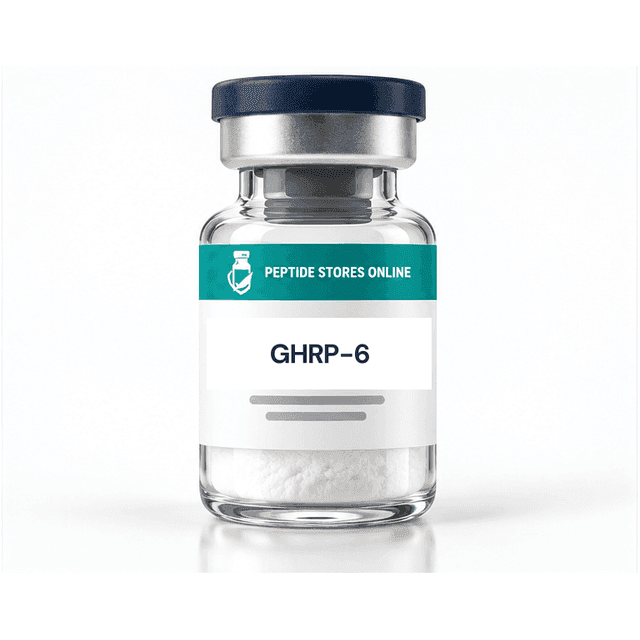
PSO vial render · Scientific images from Wikipedia · Tap to enlarge
Overview

Chemical compound
Growth hormone-releasing peptide 6 (GHRP-6), also known as growth hormone-releasing hexapeptide, is one of several synthetic met-enkephalin analogues that include unnatural D-amino acids, were developed for their growth hormone-releasing activity and are called growth hormone secretagogues. They lack opioid activity but are potent stimulators of growth hormone (GH) release. These secretagogues are distinct from growth hormone releasing hormone (GHRH) in that they share no sequence relation and derive their function through activation of a completely different receptor. This receptor was originally called the growth hormone secretagogue receptor (GHSR), but due to subsequent discoveries, the hormone ghrelin is now considered the receptor's natural endogenous ligand, and it has been renamed as the ghrelin receptor. Therefore, these GHSR agonists act as synthetic ghrelin mimetics.
Mechanism of Action
Ghrelin receptor agonist; one of the strongest hunger-stimulating GH peptides, promotes GH release and gastric motility.
What is GHRP-6?
GHRP-6 is a synthetic six-amino-acid peptide and one of the first growth hormone secretagogues ever made. It copies the action of ghrelin, the hunger hormone, at its receptor. Researchers study it for growth hormone release, appetite signaling, and stomach movement. It helped launch an entire class of compounds.
How It Works - Simply Explained
GHRP-6 switches on the growth hormone secretagogue receptor, also called the ghrelin receptor, in the pituitary and in appetite centers of the brain. That signal prompts pituitary cells to release growth hormone, and in brain circuits it activates hunger-related neurons. It works through a different receptor from GHRH peptides like sermorelin, which is why researchers have long studied the two pathways together to see how their signals combine.
What Studies Have Found
One of the original secretagogues that released growth hormone in people
Early human research in the 1990s showed this synthetic hexapeptide could trigger a clear, specific rise in growth hormone in normal men and in some children with short stature and growth hormone deficiency. The strength and reliability of that response is why GHRP-6 became a reference compound for the whole secretagogue field.
Bowers CY et al., early 1990s, Journal of Clinical Endocrinology and Metabolism research on GHRP
Its main growth hormone action sits in the brain, not just the pituitary
Researchers studying patients whose pituitary was disconnected from the brain found the growth hormone response to GHRP-6 was blocked, and its normal synergy with GHRH disappeared. They concluded the peptide's main action is exerted at the hypothalamus level in the brain, a finding that reshaped how scientists understood secretagogue signaling.
Popovic V et al., 1995, Journal of Clinical Endocrinology and Metabolism
Stress-hormone response depended on the body's starting state in rats
In conscious rats, researchers found GHRP-6 could raise ACTH and corticosterone, but the size of that response depended on how active the stress axis already was before treatment. Growth hormone responses were also larger when baseline stress hormones were low. The study is often cited as a reminder that secretagogue effects are state-dependent, not fixed.
Thomas GB et al., 1997, Endocrinology
Brain hunger circuits lit up in a 2025 mouse study
In a 2025 study, researchers delivered GHRP-6 through the nose in mice and found it increased food intake by raising both meal frequency and meal size, activated hunger neurons in the arcuate nucleus, and raised blood growth hormone. Of the ghrelin-related compounds tested that way, only GHRP-6 engaged the brain ghrelin system without adverse effects in that model.
Published 2025, Endocrinology, PMID 39813130
A modified version became a tool for blocking other receptors
Scientists created a variant called D-Lys3-GHRP-6 to block the ghrelin receptor, and later work found that same variant also blocks CXCR4, a completely different receptor involved in immune and cell-movement research. An antagonist built from GHRP-6 thus became a research tool in fields far from growth hormone, showing how one scaffold can open unexpected doors.
Patel K et al., 2012, International Journal of Biological Sciences
Last updated 2026-10-12. New findings are added as published research appears.
Frequently Asked Questions
What is GHRP-6?
GHRP-6, short for growth hormone-releasing peptide-6, is a synthetic peptide of six amino acids developed in early secretagogue research. It activates the ghrelin receptor and is sold strictly for laboratory research use, not for human consumption.
How is GHRP-6 different from GHRP-2 and ipamorelin?
All three activate the ghrelin receptor family to prompt growth hormone release in research models. GHRP-6 is the oldest and is most strongly associated in studies with hunger signaling. Ipamorelin was developed later as a more selective compound, with less effect on other hormones in comparative research.
Why is GHRP-6 linked to hunger in research?
Because it activates the same receptor as ghrelin, a natural hormone that rises before meals. Animal studies consistently observe increased food intake after GHRP-6 in research settings, and brain imaging and cell-activation studies show hunger neurons switching on.
How is GHRP-6 different from sermorelin?
They use different doors into the same outcome. Sermorelin copies the GHRH signal and acts mainly at the pituitary. GHRP-6 copies the ghrelin signal, acts through the ghrelin receptor, and much of its action appears to start in the brain. Researchers often compare the pathways side by side.
Has GHRP-6 been tested in humans?
Yes, in early clinical research from the 1990s onward, mainly to understand growth hormone release and pituitary function. It was never developed into an approved medicine, and the material sold here is for laboratory research only.
Is GHRP-6 the same as hexarelin?
No, though they are close relatives. Hexarelin is a modified cousin of GHRP-6 with a chemical change that makes it more potent and more stable in research models. They share the ghrelin receptor pathway but are distinct compounds with separate study histories.
What Researchers Are Saying
Community Reports - Not Medical Advice
The following is aggregated from public forums, Reddit, and research communities. These are anecdotal reports from researchers only - not verified clinical data and not a recommendation of any kind.
GHRP-6 (also known as ghrp6, growth hormone releasing peptide 6) is studied within the growth hormone axis and body composition research community. GH secretagogue studied for GH release and appetite stimulation via ghrelin receptor activation.
Last updated October 28, 2026
Research status: active. GHRP-6 appears across growth hormone axis and body composition research forums and academic literature. Researchers note this compound falls in the growth hormone category.
Last updated October 28, 2026
What Do You Think of This Peptide?
Share your opinion or research experience with GHRP-6. Comments are reviewed before appearing.